
(Previously International Conference on Pattern Recognition and Intelligence Systems)
Welcome to the official website of 2026 International Conference on Emerging AI Technologies (EAIT 2026) (Previously International Conference on Pattern Recognition and Intelligence Systems). To better foster communication in the AI community, the International Conference on Pattern Recognition and Intelligent Systems has been renamed the International Conference on Emerging AI Technologies. EAIT 2026 continues the legacy of the PRIS conference. EAIT 2026 will be held in Tokyo Metropolitan Tama Business Activation Center · Tokyo, Japan from Sept. 16 to 19, 2026, which is co-organized by Asia Pacific Institute of Science and Engineering (APISE) , supported by Takushoku University, technically sponsored by Association of Taiwan Electronic Commerce.
The International Conference on Emerging AI Technologies centers on the theme "AI for Humanity." We believe the true measure of technological progress is its capacity to solve engineering challenges and enhance human life. Much like the industrial revolutions of the past, AI serves as a catalyst for productivity and the evolution of the workforce. We view AI not as a replacement for human labor, but as a transformative tool to automate routine tasks, optimize complex systems, and empower the individual.
We warmly welcome prospective authors to submit their new research or technological contributions to EAIT 2026, for sharing valuable experiences with scientists and students from around the world.
Co-Organizer
Supporter

Technical Sponsor

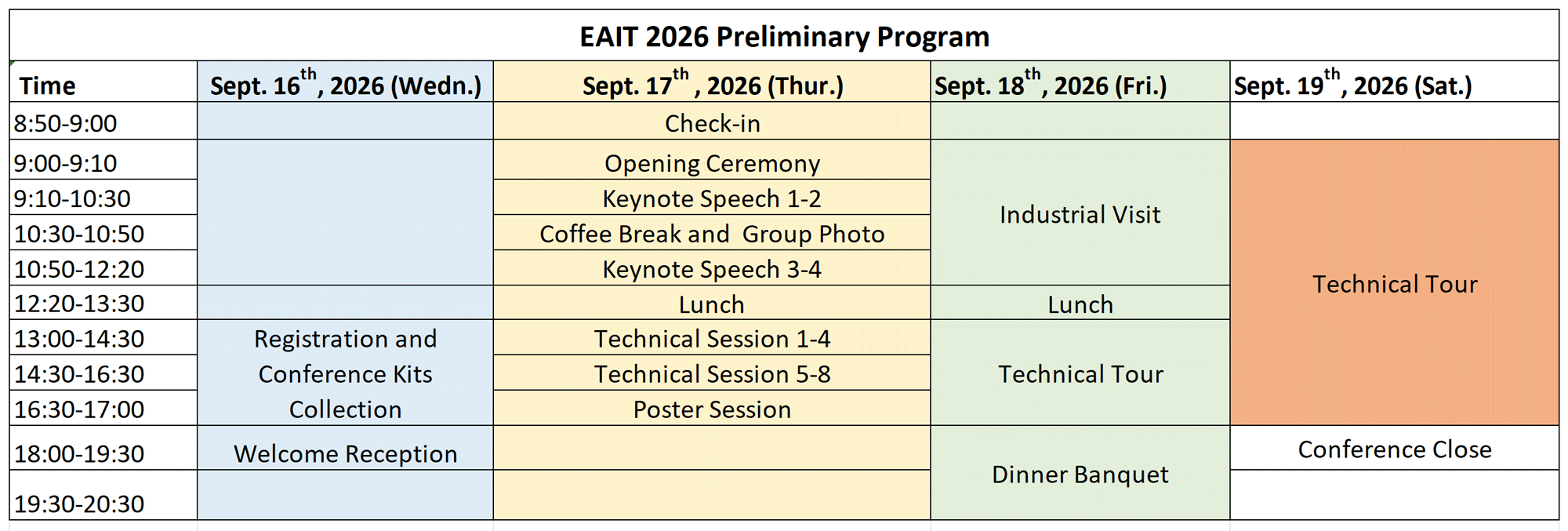
Please click on the image to view
P.s. The program is only for reference, and the final program will be available on Middle August, 2026.
1) All the registered and presented papers will be included in the volume of ACM International Conference Proceedings Series (online publishing), the publisher will submit articles to Engineering Village, Scopus, Web of Science and other databases for review and indexing after publication.




2) Selected papers with great extension will be recommended to publish in special issue of international journals:
Choice 1: Wireless Networks (Springer, SCIE, IF 2.1)
Collection: AI-powered Secure and Smart Wireless Networks
https://link.springer.com/collections/cifddiacgg
Due Date: 12/31/2026
Choice 2: Applied Sciences (MDPI, SCIE, IF 2.2)
Special Issue: Artificial Intelligence: Fundamental Research and Emerging Applications in the Era of Autonomous Systems
https://www.mdpi.com/journal/applsci/special_issues/3WE2F8CI6C
Due Date: 05/20/2027
Choice 3: Sensors (MDPI, SCIE, IF 3.5)
Special Issue: AI-Driven Intelligent Communication
https://www.mdpi.com/journal/sensors/special_issues/WPHC1C9155
Due Date: 10/24/2026 (likely will be extended)
Choice 4: CMES (Tech Scince Press, SCIE, IF 2.5)
Special Issue: Agentic AI: The New Orchestrators of Computational Engineering
https://www.techscience.com/CMES/special_detail/agentic_ai_
computational_engineering
Due Date: 3/31, 2027
Track 1: Generative Models and Synthetic Media
• Multimodal Synthesis: Latent diffusion models, transformer-based video generation, and cross-modal alignment.
• Neural Rendering: Neural Radiance Fields, 3D Gaussian Splatting, and high-fidelity 3D reconstruction.
• Computational Creativity: Algorithmic music composition, generative design, and the ethics of synthetic content.
• Digital Authenticity: Forensics for deepfake detection and cryptographic watermarking of AI outputs.
Track 2: Agentic Systems and Decentralized Intelligence
• Autonomous Agents: Task-oriented reasoning, tool-use in Large Language Models (LLMs), and self-evolving code agents.
• Swarm & Multi-Agent Intelligence: Collaborative decision-making, decentralized optimization, and agent-based social simulation.
• Adaptive Environments: Procedural content generation and behavioral modeling for non-player characters in immersive worlds.
• Human-Agent Interaction: Collaborative decision-making, trust-based delegation, and symbiotic workflows for human-AI augmentation.
Track 3: Efficiency, Edge, and Privacy-Preserving AI
• EdgeAI: TinyML architectures, model quantization, and knowledge distillation for resource-constrained devices.
• Hardware-Software Co-Design: Neuromorphic computing, low-power AI accelerators, and on-chip learning.
• Distributed Privacy: Federated learning, differential privacy, and secure multi-party computation.
Track 4: AI for Science and Engineering
• Infrastructure Resilience: AI-driven structural health monitoring and predictive maintenance for bridges, power grids, and transit systems.
• Energy Optimization: Intelligent control of smart grids, fusion energy modeling, and battery chemistry discovery.
• Physics-Informed Neural Networks: Integrating conservation laws into AI models for fluid dynamics and solid mechanics.
• Materials Informatics: Accelerating the discovery of high-performance alloys and semiconductors using generative models.
Track 5: Socio-Technical Applications and EdTech
• Precision Healthcare: AI-driven diagnostic assistance in radiology and pathology; wearable-based longitudinal health monitoring.
• Algorithmic Finance: Real-time fraud detection, automated risk assessment, and high-frequency predictive analytics.
• Next-Generation Pedagogy: Adaptive learning systems, automated feedback loops, and AI-assisted curriculum design.
• Universal Accessibility: AI-driven sensory substitution, real-time translation, and assistive mobility technologies.
Track 6: AI for Human Empowerment and Society
• Augmented Productivity: AI-human collaborative workflows and the transformation of the digital workplace.
• AI for Social Good: Mitigating global inequality, disaster response optimization, and food security.
• Ethics of Augmentation: Designing transparent and unbiased systems that prioritize human autonomy.
• Future of Labor: Economic modeling of AI-driven productivity gains and new job category creation.
• Public Trust and Literacy: Strategies for AI explainability and democratic access to foundation models.

All the papers will be peer reviewed, and each paper will be peer reviewed by 2-3 experts. It takes 20-30 days for the result coming out. If the paper needs revising, it should be resubmited for peer review again. Submitted papers are evaluated using a double-blind review process for originality, relevance, and presentation. Reviewers for a paper will be kept anonymous.
1) Manuscripts must be written in English;
2) The manuscript should be written in accordance with the standard of template;
3) The topics of paper should be relevant to conference topics;
4) Plagiarism and Duplicate submission are prohibited;
5) Innovation and scientific value is a must.
Authors can submit manuscripts through CMT electronic submission system. Please click the following link:
https://cmt3.research.microsoft.com/ICEAIT2026
First-time users should register a account firstly, then upload your paper to the system. Previous users can log in the CMT system directly.
If your paper need to be updated after you receive the submission confirmation, please send the updated paper to conference email eait@apise.org directly, please do not update in Electronic Submission System.

The Secretary office of EAIT 2026 will collect contributions and finish daily organizing work. If you have any question, please feel free to contact our conference secretary:
Ms. Sharon Chai
 |
 |
|---|---|
| APISE WeChat (Official Account) |
APISE WeChat (Consultation) |
Copyright © EAIT 2026 | www.eait.org | The pictures on the webpage are from: Canva and Wikimedia Commons